|
|
| Mission Statement | Newsletters |
| What's new |
| Become a Member |
| Join e-mail list |
| Projects |
| Videos |
| Wallpaper Images |
| Team Resources |
| Diver Standards |
| Sponsors |
| Contacts |
Consolidated PB4Y-2 Privateer
Underwater Image Gallery
Specifications
Manufacturer: Consolidated Vultee Aircraft Corporation
Type: Four-engine patrol-bomber
Crew: Eleven
Power Plant: Four 1,350 hp Pratt & Whitney R-1,830-94 radial engines
Dimensions: Span, 110 ft.; length, 74 ft.; 7 in.; height, 30 ft. 1 in.; wing area, 1,048 sq. ft.
Weights: Empty, 37,485 lbs; gross, 65,000 lb.
Performance: Maximum speed, 237 mph at 13,750 ft.; cruising speed, 140 mph; initial climb rate, 1,090 ft. per min; service ceiling, 20,700 ft.; range, 2,800 miles.
Armament: Twelve flexible .50 caliber machine guns in waist and power-operated nose, dorsal, and tail turrets, and up to 1.600 pounds of bombs.
History
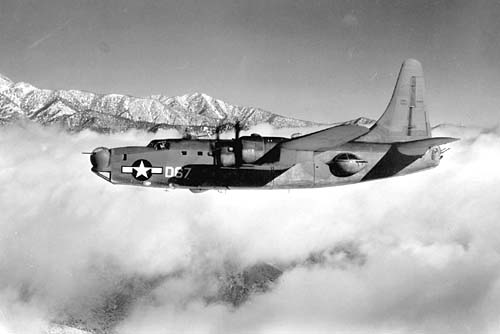
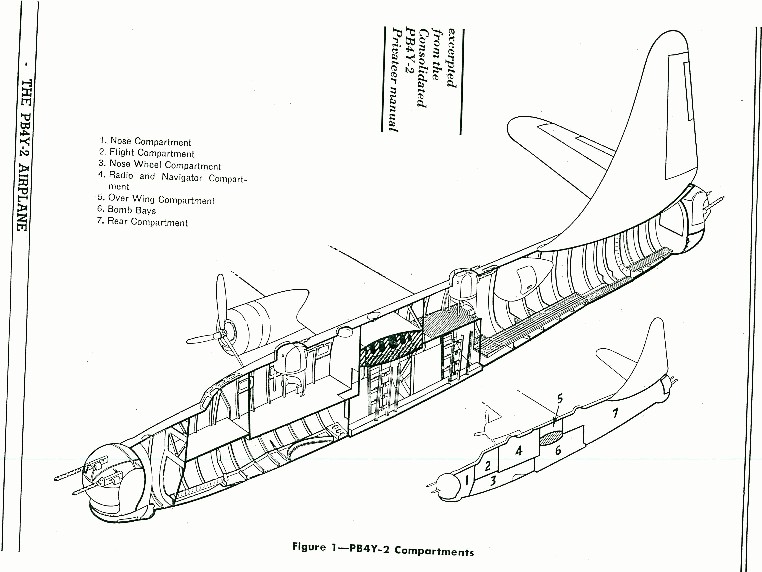
The Privateer is a variant of the B-24, redesigned for the Navy to have better performance at low altitudes. A seven-foot extension was added to the forward fuselage to accommodate a flight engineer’s station. The engines were changed to the non-supercharged 1,350- hp Pratt & Whitney R-1830-94. The twin-tail was changed to a single tail fin and rudder. The armament was also beefed up. Most PB4Y-2s carried two Martin A-3 power turrets mounted on the dorsal spine, one immediately behind the cockpit and one immediately ahead of the vertical tail. The nose had the ERCO 250 SH ball turret and the tail carried a standard Consolidated A-6B turret. The flexible waist machine guns were replaced with ERCO 250 teardrop-shaped waist blisters. Each blister contained an internal powered ball turret which allowed both fore and aft traverse as well as up and down movement. Each blister carried a pair of .50 caliber machine guns. Given the protection provided by these blisters, the belly ball turret was eliminated.
The Privateer entered Navy service during the late summer of 1944. The aircraft was used exclusively in the Pacific theatre (WWII), where it was used primarily for patrol missions in support of amphibious operations during the latter stages of the war. No other Navy aircraft had the Privateer’s range and versatility. Navy Privateers also performed a variety of other missions - they searched out and destroyed enemy radar, ships and other targets. They reported on weather and enemy positions, and located downed airmen and coordinated rescue operations.
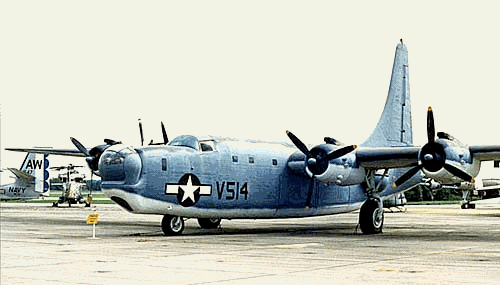
Following the end of the war, six Navy squadrons continued to fly Privateers, and the aircraft flew numerous missions during the Korean War. In 1951, the Privateers still in service were redisignated P4Y-2. The top turrets were removed from some of the planes to improve their range and speed.
The PB4Y-2 Privateer in Lake Washington (BuNo 59695) was stationed at NAS Seattle at Sand Point at the time of the crash and flown by Navy Reserve pilots.
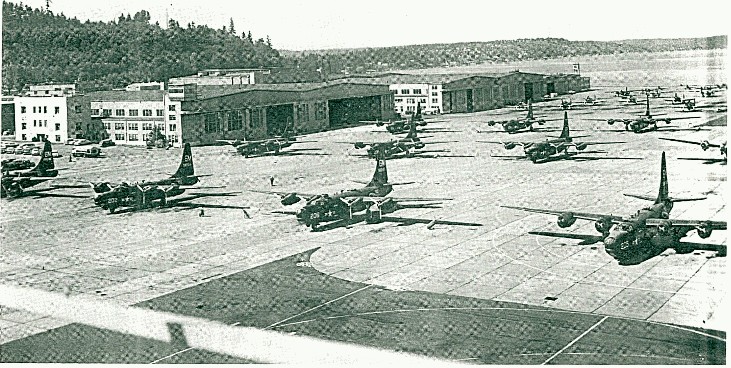
In July 1956, the aircraft was flown to Hawaii on a two-week training mission. On August 25, 1956, the aircraft was flown on an uneventful training flight. The following day, on August 26, 1956, the aircraft crashed into the Lake shortly after take-off on a routine training flight.
PB4Y-2 in Lake Washington
Underwater Image Gallery
The airplane sits upright on the bottom off Sand Point. The tail of the airplane points towards shore and the nose points across the lake towards Kirkland on a 70 heading. The bottom depth is approximately 150 feet at the tail of the airplane and approximately 158 feet at the nose. The bottom is soft sediment. Visibility ranges from 5 to 10 feet. The airplane is covered with a very fine layer of silt, which is easily brushed away.
The airplane appears to be resting on its nose landing gear, the outer port engine, and the landing gear under the wing on the starboard side. The tip of the port wing rests on the bottom at a depth of 148 feet and is covered by silt. The portside landing gear is down, but only the top two or three feet of the landing gear is visible above the bottom. You cannot tell if the portside landing gear is intact with the wheel completely buried or if the lower portion of the portside landing gear is gone. The tip of the starboard wing is at a depth of 142 feet and about six feet above the bottom. The starboard wing is supported by the starboard landing gear and this landing gear, including the wheel, is visible above the bottom.
On the tail of the airplane, the vertical tail and port horizontal stabilizer appear to be in relatively good condition. The tip of the starboard horizontal stabilizer, however, is badly damaged. The rudder on the vertical tail can be moved back and forth by hand. The tail gun turret is intact and turned all the way to port. The turret contains two machine guns, which are pointing down toward the bottom and appear to be very rusty.
The "blisters" for the waist machine guns appear to be in good condition, but they do not have any machine guns protruding out of them. You can see the two holes in the track across the center of the blisters where the machine guns are suppose to be. You cannot see inside the blisters.
There is an open hatch on the top of the airplane between the tail and the wings. The opening is rectangular, approximately 18 inches by 24 inches and the hatch cover is hanging down inside the airplane from the starboard side. This hatch offers access to a large compartment in the tail of the airplane. The pod (radar?) on the top of the aircraft over the wings is there, but damaged. There is another open hatch on the top of the airplane immediately aft of the cockpit. This hatch is round, approximately 24 inches in diameter, and the hatch cover is hanging down inside the airplane from the port side. This hatch probably offers access to the cockpit and flight engineer’s compartment.
The cockpit windows in front of the pilot and copilots seats are in place. The windows on the port and starboard sides of the cockpit are open. The sliding window covering is still in place behind the pilot’s window on the port side of the airplane, but the sliding window covering is missing on the co-pilot’s window on the starboard side. These two open windows allow a clear view of the inside of the cockpit. The cockpit is intact and appears to be in relatively good condition. The flight instruments are in the dashboard and the throttle controls are in place between the pilot and co-pilots seat. The flight instruments are readable. The pedals are visible on the floor beneath each seat. The metal pilots’ seats are very rusty and there is a fair amount of rust visible on the dashboard around the flight instruments. The flight instruments themselves do not appear to be rusty.
The nose gun turret is in place and faces forward. The turret contains two machine guns, which are pointing straight out. The machine guns appear to be very rusty. The nose of the airplane is supported by the nose landing gear. However, only the strut is visible; the nose wheel is buried in the silt.
The bomb bay doors on the underside of the airplane are open and probably offer access into the airplane. However, the space between the bottom of the lake and the bottom of the bomb bay doors is not very big.
Both of the inner engines (close to the body) are gone. There is an opening in each wing where the engines used to be. There is a fair amount of debris on the bottom below each of these areas. The outer port engine is intact and two of the blades on the propeller appear to be in good condition. The third blade on the port propeller is buried in the bottom. The base of the outer port engine is resting on the bottom and appears to be supporting the port wing. The covers on the outer engine casing can be opened and closed by hand and, when open, offer a good view of the engine. The outer starboard engine is intact and all three blades on the propeller on this engine appear to be in good condition. The covers on the outer engine casing can be opened and closed by hand and, when open, offer a good view of the engine.
There is a fair amount of rust visible on the airplane. Items like the machine guns and the metal pilots’ seats are very rusty. The holes in the barrels of the machine guns are almost completely filled with rust. There is also rust on the aluminum skin of the airplane, especially around the rivets and other areas where dissimilar metals are in close proximity to each other. However, it is still possible to see the markings (white star, warnings, etc.) painted on the skin when you brush the silt away. We do not know at this point whether the condition of the airplane has "stabilized" or is continuing to deteriorate. To determine this, it will be necessary to monitor the condition of the airplane over a period of time.
The PB4Y-2 in the lake does not have two dorsal gun turrets along the top of the airplane and, thus, could not have contained the 12 machine guns that are usually reported to be on PB4Y-2s. This plane would have carried only eight machine guns-- two in the nose turret, two in each waist blister, and two in the tail turret.
The aircraft is the property of the US Navy, which prohibits the removal of artifacts from the site.